
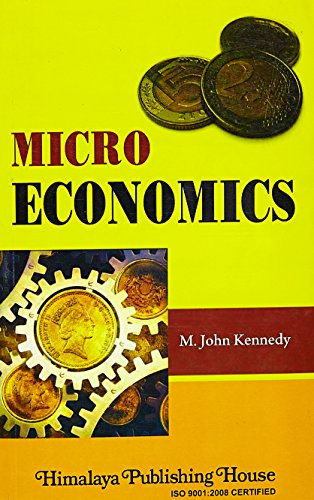
Micro economics
Material type: TextLanguage: English Publication details: Mumbai; Himalaya publishing house, 2019.Edition: 1Description: 498pISBN:
 - 9789351427957
- 338.5 KEN/M
| Item type | Current library | Home library | Collection | Call number | Status | Barcode | |
|---|---|---|---|---|---|---|---|
 Book
Book
|
Dept. of Economics Processing Center | Dept. of Economics | Non-fiction | 338.5 KEN/M (Browse shelf(Opens below)) | Available | ECN17035 |
CONTENTS
1.PART ONE: INTRODUCTION1. DEFINITION OF ECONOMICS
Wealth Definition, Welfare Definition, Scarcity Definition, Growth Definition.
2. METHODS AND NATURE OF ECONOMIC LAWS
Deductive Method – Merits – Demerits – Inductive Method – Merits – Demerits – Economics as a Science – Economics as an Art – Nature of Economic Laws – Positive and Normative Approaches.
3. MICRO ECONOMICS AND MACRO ECONOMICS
Meaning of Micro Economics – Importance of Micro Economics – Limitations of Micro Economics – Macro Economics – Distinction between Micro and Macro Economics – Limitations of Macro Economics – Integration of Micro Economics and Macro Economics – Importance of Macro Economics.
4. ECONOMY – ITS VITAL PROCESSES AND BASIC PROBLEMS
What is an Economy? The Vital Functions of an Economy – Central Problems of an Economy – Production Possibility Curve – Uses of Production Possibility Curve.
5. THE CONCEPT OF EQUILIBRIUM
Meaning – Classification of Equilibrium – Stable, Unstable and Neutral Equilibrium – Short Run and Long Run Equilibrium – Static and Dynamic Equilibrium – Unique and Multiple Equilibrium – Partial and General Equilibrium.
6. ECONOMIC STATICS AND DYNAMICS
Meaning of Economic Statics – Comparative Statics – Economic Dynamics – Comparison between Economic Statics and Dynamics.
PART TWO: THEORY OF CONSUMER BEHAVIOUR7. LAW OF DEMAND
Meaning of Demand – Demand Function – Demand Schedule – Market Demand Curve – Types of Demand – Law of Demand – Why the Demand Curve Slopes Downwards? – Exceptions to the Law of Demand – Movement Along and Shift in the Demand Curve – Derivation of the Law of Demand from the Law of Diminishing Marginal Utility.
8. CARDINAL UTILITY THEORY
Meaning of Utility – Cardinal and Ordinal Utility – Assumptions of Cardinal Utility Analysis – Law of Diminishing Marginal Utility – Relationship between Marginal Utility and Total Utility – Reasons for Diminishing Marginal Utility – Assumptions of the Law – Exceptions – Importance – Law of Equi-Marginal Utility – Assumptions – Principle – Diagrammatic Explanation – Limitations – Importance – Critical Evaluation of Marginal Utility Analysis.
9. INDIFFERENCE CURVE ANALYSIS
Introduction – Meaning of Indifference Schedule – Indifference Curve – Indifference Map – Marginal Rate of Substitution – Diminishing MRS – Properties of Indifference Curves – Consumer’s Equilibrium – Income Effect Substitution Effect – Income and Substitution Effects of a Price Change – The Hicksian Method – The Slutskian Method – Hicksian Approach Vs. Slutskian Approach – The Giffen Paradox – Normal or Inferior Goods and Income Effects, Derivation of Demand Curve from the Price Consumption Curve – Superiority of Indifference Curves Over the Marshallian Utility Analysis – A Critical Evaluation.
10. CONSUMER’S SURPLUS
Introduction – Consumer’s Surplus and the Law of Diminishing Marginal Utility – Consumer’s Surplus for an Individual Consumer – Consumer’s Surplus for a Market – Consumer’s Surplus and Society – Market Price and Consumer’s Surplus – Assumptions of the Theory – Criticism – Theoretical and Practical Importance – Measurement of Consumer’s Surplus – Indifference Curve Approach.
11. ELASTICITY OF DEMAND
Law of Demand and Elasticity of Demand – Definition of Price Elasticity – Degrees of Price Elasticity of Demand – Co-efficient of Elasticity – Measurement of Elasticity – Factors Determining Elasticity of Demand Importance of the Concept – Other Types of Elasticity – Income Elasticity of Demand – Types of Income Elasticity.
PART THREE: THEORY OF PRODUCTION12. FACTORS OF PRODUCTION
Meaning of Factors of Production – Land – Meaning – Characteristics of Land – Labour – Meaning – Peculiarities of Labour – Efficiency of Labour – Capital – Meaning – Characteristics of Capital – Functions of Capital – Classification of Capital – Capital Formation – Division of Labour – Theories of population.
13. SCALE OF PRODUCTION
Meaning of Internal Economies – Types of Internal Economies – External Economies – Meaning and Types of External Economies – Advantages and Disadvantage of Large Scale Production – Advantages and Disadvantages of Small Scale Production.
14. THE THEORY OF PRODUCTION FUNCTION
Meaning of Production Function – The Law of Returns to Scale – Optimum Combination of Factors – The Law of Variable Proportions – Diminishing and Increasing Returns.
15. ISOQUANTS AND THE THEORY OF PRODUCTION
Meaning of Isoquants – Isoquants Schedule – Isoquant Curve – Isoquant Map – Isoquants Vs. Indifference Curves – Properties of Isoquants – Marginal Rate of Technical Substitution – Limitations – Producers Equilibrium – Isoquants and Returns to Scale.
PART FOUR: THEORY OF PRODUCT PRICING16. COST AND COST CURVES
Introduction – Money Cost and Real Cost – Private, External and Social Costs – Implicit Cost and Explicit Cost – Historical and Replacement Cost – Increment and Sunk Costs – Opportunity Cost – Short Run and Long Run Cost Curves – Short Run Fixed and Variable Costs – Cost Schedule – Total Fixed Cost – Total Variable Cost – Total Cost – Average Fixed Cost – Average Variable Cost – Average Cost – Why the Short Run Average Cost Curve is ‘U’ Shaped? Marginal Cost – Long Run Cost Analysis – Planning Curve – ‘L’ Shaped Long Run Average Cost Curve – Long Run Marginal Cost Curve.
17. REVENUE AND REVENUE CURVES
Introduction – Total Revenue – Average Revenue and Marginal Revenue – Relationship between AR and MR Curve – Under Perfect Competition – Under Imperfect Competition – Some Special Cases of Revenue Curves.
18. SUPPLY
Meaning of Supply – Stock and Supply – The Law of Supply – Factors Determining the Supply of a Commodity – Exceptions to the Law of Supply – Extension and Contraction in Supply – Increase and Decrease in Supply – Elasticity of Supply – Kinds of Supply Elasticity – Measurement of Elasticity of Supply – Factors Determining Elasticity of Supply – Practical Uses of Elasticity of Supply – Derivation of Supply Curve – Industry’s Supply Curve in the Short Run – Industry’s Supply Curve in the Long Run – Constant Cost Industry – Increasing Cost Industry – Decreasing Cost Industry.
19. MARKET AND MARKET STRUCTURE
Meaning of Market – Features of Market – Classification of Markets – Factors Affecting the Size of a Market.
20. EQUILIBRIUM OF FIRM AND INDUSTRY UNDER PERFECT COMPETITION
Meaning – The Assumptions of Perfect Competition – Perfect Competition in Practice – Equilibrium of the Firm – Short Run Equilibrium under Identical Cost Conditions – Different Cost Conditions – Short Run Equilibrium in Terms of TR-TC Analysis – Long Run Equilibrium – Identical Cost Conditions – Different Cost Conditions.
21. PRICING UNDER PERFECT COMPETITION
Introduction – Graphic Illustration – Importance of Time Element in Price Theory – The Market Period – Short Run Period – Long Run Period – Long Run Normal Price in Constant Cost Industry – Increasing Cost Industry and Decreasing Cost Industry – Secular Period – Distinction between Normal Price and Market Price.
22. MONOPOLY
Definition – Characteristics – Types – Causes of Monopoly – Pure Monopoly – Price and Output Decisions in the Short Run – Total Revenue – Total Cost Approach – Monopoly Equilibrium in the Long Run – Regulation of Monopoly – Monopoly and Perfect Competition Compared.
23. PRICE DISCRIMINATION
Meaning – Forms of Price Discrimination – Degrees of Price Discrimination – When Price Discrimination is Possible – Profitable – Effects of Price Discrimination – Is Price Discrimination Beneficial to Society? – Dumping – Meaning – Motives of Dumping – Price Output Determination under Dumping.
24. MONOPSONY AND BILATERAL MONOPOLY
25. MONOPOLISTIC COMPETITION
Definition – Features – Equilibrium under Monopolistic Competition – Price Problem – Nature of Product – Advertising Outlay – Individual Equilibrium – Short Run Equilibrium – Long Run Equilibrium – Excess Capacity – Group Equilibrium – Problems in Group Equilibrium: Closed Entry, Open Entry – Selling Cost – Difference Between Production Cost and Selling Cost – Wastages of Monopolistic Competition.
26. DUOPOLY
Meaning – The Cournot Model – The Chamberlin Model – The Edgeworth Model – Hotellings Spatial Equilibrium Model. The Stackelberg Model.
27. OLIGOPOLY
Meaning – Main Features – Classification of Oligopoly – Price Determination under Imperfect Oligopoly (Price Leadership) – Meaning of Price Leadership – Price Leadership by a Low-Cost Firm – Price Leadership by a Dominant Firm – Barometric Price Leadership – Pricing under Perfect Collusion (Cartels) – Meaning – Price Fixing in an Ideal Cartel – Cartels and Market Sharing – Pricing under Non-collusive Oligopoly – (Kinked – Demand Curve) Reasons for Price Rigidity – Changes in Cost – Changes in Demand – Implications – Criticisms.
PART FIVE: THEORY OF FACTOR PRICING
28. DISTRIBUTION
Meaning of Distribution – Functional and Personal Distribution – Marginal Productivity Theory of Factor Pricing – Critical Evaluation of the Marginal Productivity Theory.
29. RENT
Different Concepts of Rent – Ricardian Theory of Rent – Assumptions – How does Rent Arise? – Intensive Cultivation –
Extensive Cultivation – Critical Evaluation of the Ricardian Theory – Quasi Rent – Differences between Rent and Quasi Rent – Modern Theory of Rent.
30. WAGES
Meaning – Nominal Wage and Real Wage – Factors Determining Real Wage – Subsistence Theory of Wages – The Standard of Living Theory of Wages – The Wages Fund Theory – Residual Claimant Theory – Marginal Productivity Theory of Wages – Discounted Marginal Productivity Theory – Modern Theory of Wages.
31. INTEREST
Definition – Gross Interest and Net Interest – Why Interest is Paid? – Marginal Productivity Theory of Interest – Abstinence or Waiting Theory of Interest – Agio Theory of Interest – Fisher’s Time Preference Theory – Classical Theory of Interest – Loanable Funds Theory of Interest – Liquidity Preference Theory of Interest – Modern Theory of Interest.
32. THEORY OF PROFIT
Meaning – Gross Profit and Net Profit – Rent Theory of Profit – Wage Theory of Profit – Dynamic Theory of Profit – Risk Theory of Profit – Uncertainty Bearing Theory of Profit – Innovation Theory of Profit – Marginal Productivity Theory of Profit.
There are no comments on this title.