
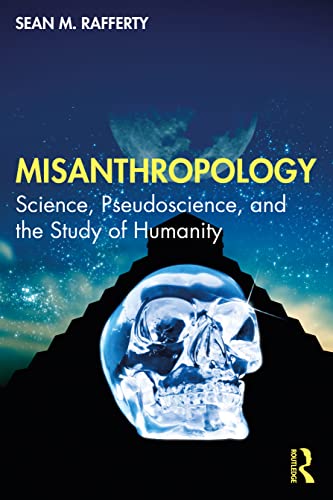
MISANTHROPOLOGY SCIENCE, PSEUDOSCIENCE AND THE STUDY OF HUMANITY
Material type: TextPublication details: New York Routledge 2023Description: 183p. PBISBN:
 - 9781032231778
- 301.01 RAF.M
| Item type | Current library | Home library | Call number | Status | Barcode | |
|---|---|---|---|---|---|---|
 Book
Book
|
Dept. of Archaeology Processing Center | Dept. of Archaeology | 301.01 RAF.M (Browse shelf(Opens below)) | Available | AGY5861 |
Misanthropology: Science, Pseudoscience, and the Study of Humanity introduces students to key concepts in critical thinking across the four core branches of anthropology: cultural, linguistic, biological, and archaeological. It combines a critical analysis of anthropology as a field with current concepts in scientific skepticism.
By deconstructing a range of global case studies in which anthropological research runs aground, the book teaches students to distinguish between legitimate science and pseudoscience. It covers key concepts in critical thinking and rigorous research, such as cognitive biases and logical fallacies, data collection and consensus, probabilistic thinking, as well as political, nationalist, racist biases. Students learn not only how to apply these concepts to anthropological research and fieldwork, but also to their consumption of everyday information.
This book will appeal to anthropology students and will be particularly useful for instructors of introductory anthropology courses, as well as instructors of courses across the humanities and social sciences focused on inculcating critical thinking skills.
There are no comments on this title.