
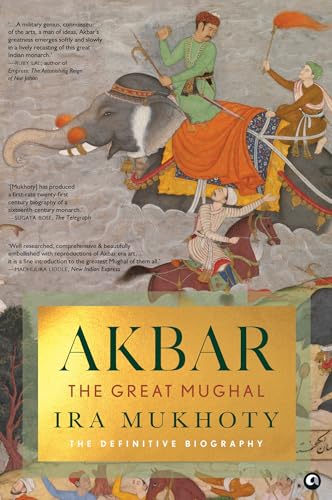
AKBAR : THE GREAT MUGHAL / BY IRA MUKHOTY
Material type: TextLanguage: English Publication details: NEW DELHI : ALEPH BOOK COMPANY , 2025 .Description: 543pISBN:
 - 9789389836226
- 23 954.025 MUK/A
| Item type | Current library | Home library | Call number | Status | Barcode | |
|---|---|---|---|---|---|---|
 Book
Book
|
Dept. of Arabic General Stacks | Dept. of Arabic | 954.025 MUK/A (Browse shelf(Opens below)) | Available | ARA11661 |
Browsing Dept. of Arabic shelves,Shelving location: General Stacks Close shelf browser (Hides shelf browser)

|

|

|

|

|
No cover image available No cover image available |

|
||
| 954.01 PAR/A Ancient Indian Historical Tradition | 954.01 RAM/ H history of ancient India | 954.02 BAL/J JAHANGIR /ജഹാംഗീർ | 954.025 MUK/A AKBAR : THE GREAT MUGHAL / | 954.03 FAR/G GOVERNORS OF EMPIRE : THE EAST INDIA COMPANYS CHIEF FUNCTIONARIES IN INDIA / | 954.035 MIN/P PRANAMAM/പ്രണാമം | 954.0350 SIM/A The art of satyagraha |
Abu’l Fath Jalal-ud-din Muhammad Akbar, the third Mughal emperor, is widely regarded as one of the greatest rulers in India’s history. During his reign, the Mughal Empire was one of the wealthiest in the world, and covered much of the Indian subcontinent. Although there are dozens of books on the empire, there are surprisingly few full-length accounts of its most remarkable emperor, with the last major study having been published over two decades ago. In Akbar: The Great Mughal, this outstanding sovereign finally gets his due, and the reader gets the full measure of his extraordinary life. Akbar was born on 15 October 1542 and after a harrowing childhood and a tumultuous struggle for succession following the death of his father, Humayun, became emperor at the age of thirteen. He then ruled for nearly fifty years, and over the course of his reign established an empire that would be hailed as singular, both in its own time and for posterity. In this book, acclaimed writer Ira Mukhoty covers Akbar’s life and times in lavish, illuminating detail. The product of years of reading, research, and study, the biography looks in great detail at every aspect of this exceptional ruler—his ambitions, mistakes, bravery, military genius, empathy for his subjects, and path-breaking efforts to reform the governance of his empire. It delves deep into his open-mindedness, his reverence towards all religions, his efforts towards the emancipation of women, his abolishing of slavery and the religious tax—jiziya—and other acts that showed his statesmanship and humanity. The biography uses recent ground-breaking work by art historians to examine Akbar’s unending curiosity about the world around him, and the role the ateliers played in the succession struggle between him and his heir, Prince Salim (who became Emperor Jahangir). Beautifully written, hugely well-informed, and thoroughly grounded in scholarship, this monumental biography captures the grandeur, vitality, and genius of the Great Mughal.
IN ENGLISH
There are no comments on this title.