
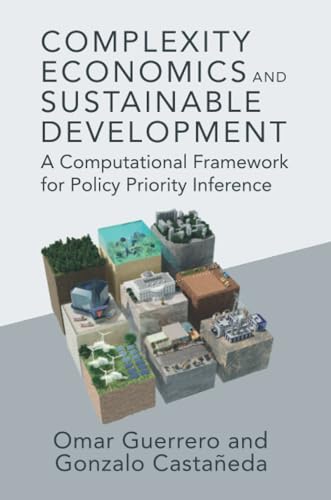
Complexity economics and sustainable development : computational framework for policy priority inference /By Omar A. Guerrero and Gonzalo Castañeda
Material type: TextLanguage: English Publication details: UK: Cambridge University Press, 2024.Edition: 1Description: 392pISBN:
 - 9781009016544
- 338.927 GUE/C
| Item type | Current library | Home library | Collection | Call number | Status | Barcode | |
|---|---|---|---|---|---|---|---|
 Book
Book
|
Dept. of Economics Processing Center | Dept. of Economics | Reference | 338.927 GUE/C (Browse shelf(Opens below)) | Not For Loan | ECN16979 |
Browsing Dept. of Economics shelves,Shelving location: Processing Center,Collection: Reference Close shelf browser (Hides shelf browser)


The Sustainable Development Goals are global objectives set by the UN. They cover fundamental issues in development such as poverty, education, economic growth, and climate. Despite growing data across policy dimensions, popular statistical approaches offer limited solutions as these datasets are not big or detailed enough to meet their technical requirements. Complexity Economics and Sustainable Development provides a novel framework to handle these challenging features, suggesting that complexity science, agent-based modelling, and computational social science can overcome these limitations. Building on interdisciplinary socioeconomic theory, it provides a new framework to quantify the link between public expenditure and development while accounting for complex interdependencies and public governance. Accompanied by comprehensive data of worldwide development indicators and open-source code, it provides a detailed construction of the analytic toolkit, familiarising readers with a diverse set of empirical applications and drawing policy implications that are insightful to a diverse readership
Contents
List of Figures
List of Tables
Foreword by Luis F. López Calva and Robert Axtell
Acknowledgements
List of Abbreviations
PART 1 A COMPLEXITY APPROACH TO
SUSTAINABLE DEVELOPMENT
1 Introduction
1.1 Motivation for This Book
1.2 Cutting-Edge Methods for Challenging Goals
1.3 The ‘Policy Priority Inference’ Research Programme
1.4 Target Audience
1.5 Structure of the Book
2 Policy Prioritisation, Complexity, and Agent Computing
2.1 Modelling the Expenditure–Development Link
2.2 Generative Causation and Social Mechanisms
2.3 On Causal Inference and Agent Computing
2.3.1 The Identification of Counterfactuals
2.3.2 The Workings of the Dependency and
Generative Accounts
2.3.3 The Validity of Agent-Computing Counterfactuals
2.3.4 The Benefits of Using Agent Computing for
Policy Evaluations
2.4 Summary and Conclusions
3 Relevant Data and Empirical Challenges
3.1 A Worldwide Look at Sustainable Development through Data
3.1.1 SDGs and Indicators
3.1.2 Pre-processing Indicators and Descriptive Statistics
3.1.3 Countries and Government Spending
3.2 Popular Modelling Frameworks and Their Limitations
3.2.1 Benchmark Analysis
3.2.2 Regression Analysis
3.2.3 General Equilibrium Models
3.2.4 System Dynamics
3.2.5 Network Analysis
3.3 Empirical Challenges
3.3.1 Adapting to Coarse-Grained Indicators
3.3.2 Moving beyond Associations
3.3.3 Handling Complex Expenditure Linkages
3.3.4 Embedding Vertical Mechanisms
3.3.5 Estimating Interdependency Networks
3.4 Summary and Conclusions
4 A Computational Model
4.1 Policy Instruments
4.2 Indicator Dynamics
4.3 Public Servants
4.4 Central Authority
4.5 Development Outcomes
4.6 Summary and Conclusions
5 Calibration and Validation
5.1 Calibration Strategy
5.2 Optimisation Algorithm
5.3 Goodness of Fit
5.4 On Statistical Confidence and Testing
5.5 Validation
5.5.1 Out-of-Sample Inference
5.5.2 Comparison with Alternative Models
5.5.3 Sensitivities and Specification Checks
5.6 Summary and Conclusions
PART 2 APPLICATIONS TO POLICY AND DEVELOPMENT
6 The ‘Policy Priority Inference’ Framework
6.1 The Policy Space
6.2 The Space of Mechanisms
6.3 Identification of Social Mechanisms
6.3.1 The Search for Dependencies
6.3.2 The Role of Theory and Generative Mechanisms
6.3.3 Mechanistic Consistency
6.4 Policy Inference and the Estimation of Policy Effects
6.5 Sensitivity Analysis and Robustness Checks
6.6 Summary and Conclusions
7 Case Studies in Development Policy
7.1 Education
7.1.1 The Role of Public Spending
CONTENTS xi
PART III A FOCALISED VIEW OF SUSTAINABLE DEVELOPMENT
10 Subnational Development and Fiscal Federalism
10.1 On Fiscal Federalism
10.1.1 Fiscal Decentralisation in Mexico
10.2 Data
10.2.1 Development Indicators
10.2.2 Development Clusters
10.2.3 Expenditure Data
10.3 Simulation Strategy
10.4 Results
10.4.1 The Impact of Contributions
10.4.2 Optimising Contributions
10.4.3 Policy Priorities and Contributions
10.5 Summary and Conclusions
11 Accelerators and Systemic Bottlenecks
11.1 Accelerators, Bottlenecks, and Their Empirical
Quantification
11.2 Data
11.2.1 Government Expenditure
11.2.2 Development Indicators
11.3 Simulation Strategy
11.3.1 Counterfactual Budgets
11.3.2 Detection of Bottlenecks and Accelerators
11.4 Results
11.4.1 Identification of Systemic Bottlenecks
and Accelerators
11.4.2 Comparison against Naïve Approaches
11.4.3 Disaggregation of Systemic Bottlenecks and
Accelerators
11.5 Summary and Conclusions
xii CONTENTS
12 Deprivation, Income Shocks, and Remittances
12.1 Socioeconomic Deprivation in the Mexican Context
12.1.1 The Importance of Remittances and Research
Design
12.2 Data
12.2.1 Indicators
12.2.2 Social Expenditure
12.2.3 Household Spending and Remittances
12.2.4 The Complex Structure of Government
Spending and Development
12.3 Simulation Strategy
12.4 Results
12.4.1 Impact Evaluation by Expenditure Source
12.4.2 Shock Mitigation via Government Expenditure
12.5 Summary and Conclusions
13 Lessons and Reflections
13.1 Lessons Learnt
13.2 From Analysis to Policy Guidelines
13.2.1 Workflow for Strategic Planning
13.3 A Call for Computational Social Scientists
13.3.1 Necessary Infrastructure
13.3.2 Upgrading Skills in Technical Teams
13.3.3 Updating Social Science Programmes
Bibliography
Index
There are no comments on this title.