
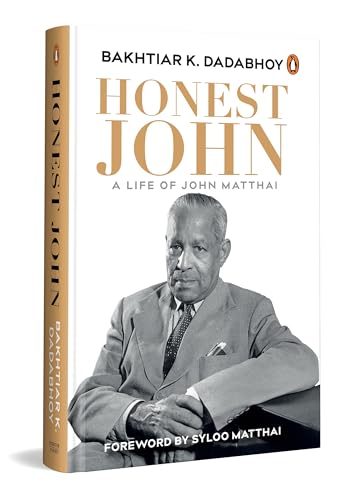
HONEST JOHN : A LIFE OF JOHN MATTHAI / BY BAKHTIAR K. DADABHOY
Material type: TextLanguage: English Publication details: INDIA : PENGUIN RANDOM HOUSE , 2025 .Description: 396pISBN:
 - 9780143468493
- 23 954.04 DAD-H
| Item type | Current library | Home library | Call number | Materials specified | Status | Barcode | |
|---|---|---|---|---|---|---|---|
 Book
Book
|
Dept. of Arabic General Stacks | Dept. of Arabic | 954.04 DAD-H (Browse shelf(Opens below)) | TEXT | Available | ARA11728 |
John Matthai was independent India’s first railways and transport minister. Later, he was India’s second finance minister but resigned due to his differences with Pandit Nehru over the Planning Commission. Matthai served in important position in the Tatas and was a friend and confidant of J.R.D. Tata. He was chairman of the Taxation Enquiry Commission (1953), which provided a framework for the future tax policies of the government. Matthai was the first chairman of the State Bank of India of the court of governors of the Administrative Staff College of India, Hyderabad, and of the National Book Trust. He was also the founder-president of the National Council of Applied Economic Research, New Delhi.
Drawing from numerous primary and secondary sources this comprehensive biography introduces Matthai to a new generation, even as it rekindles the memory of a man who has become the victim of collective amnesia. Meticulously researched and engagingly written, it also provides a window to that period in history: Matthai’s life and work provide a picture of those tumultuous times as well as describe the thinking that went into the making of modern India. This biography fills an important gap by throwing light on one of the more substantial, but now forgotten men, in the public life of those times.
IN ENGLISH
There are no comments on this title.